
The ample volumes of residual forest fibre energy available across North America is evidenced by the increasing number and ferocity of wildfires in the US and Canada
PART I: https://madisonsreport.com/woody-biomass-to-energy-forest-residue/
PART II: https://madisonsreport.com/woody-biomass-to-energy-electricity-production/
Recently Madison’s had the opportunity to visit a biomass fuel-to-electricity production facility through the University of British Columbia’s Faculty of Forestry & Environmental Stewardship’s Combined Heat and Power (CHP) Academy, based at the Alex Fraser Research Forest in central BC. Here is the third of three stories detailing those excellent projects:
Deriving Energy from Residual Timber
According to the US Energy Information Administration, global energy consumption is projected to rise significantly in the coming decades. Biomass offers a promising alternative to fossil fuels, aiming to curb climate change impacts. Given that biochemical processes like anaerobic digestion, fermentation, enzymatic hydrolysis, and composting have garnered significant attention, there is a pressing need to examine their efficacy and limitations.
Lignocellulosic biomass is the most abundant, sustainable, and non-food renewable energy source for producing
second-generation biofuels, including bioethanol, biodiesel, biogas, and solid fuels like pellets. Ligno-cellulosic biomass comprises organic materials like cellulose, hemicellulose, and lignin, which are processed for biofuels and energy. These materials are highly valuable for renewable energy, providing a sustainable alternative to fossil fuels while reducing greenhouse gas emissions.
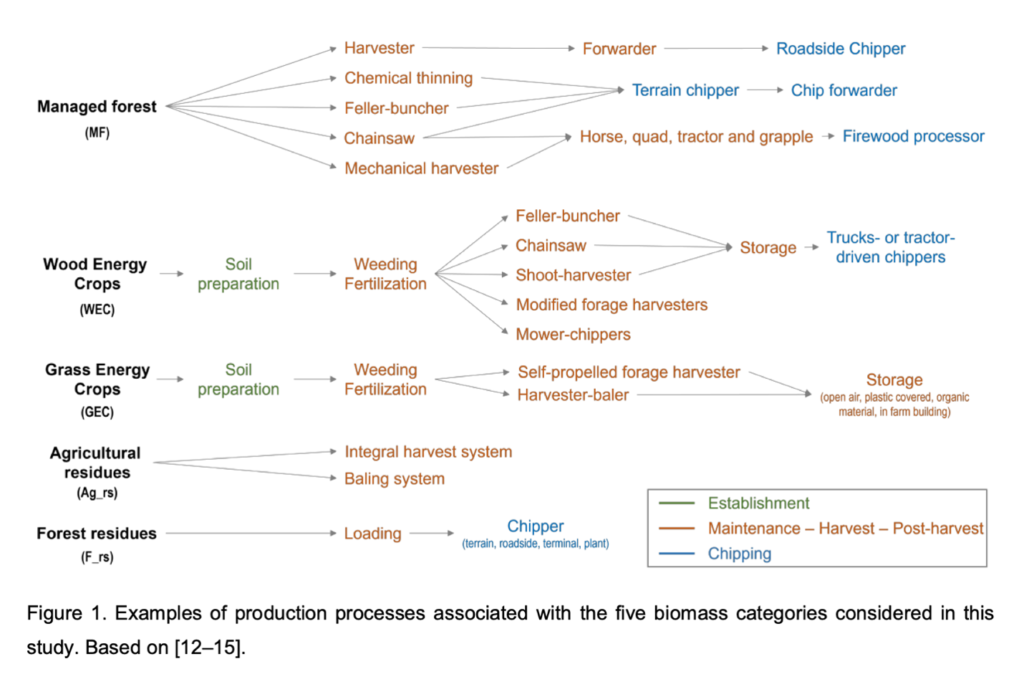
Five types of ligno-cellulosic biomass: managed forest, wood energy crops, grass energy crops, agricultural residues, and forest residues.
Woody biomass is any woody material from trees or shrubs. In a forest, timber (sawtimber and pulpwood) is usually the most valuable product, so forest woody biomass for energy usually comes from the trees and woody debris or residues that cannot be used for timber. This can include:
- Trees cut during a “thinning” operation when the stand is too densely planted
- Trees left after all other economic materials are removed during a timber harvest, such as twisted or diseased trees
- Cut residues left after a timber harvest, which can include small-diameter logs, branches and limbs, bark, needles, and stumps
Typically, logging residues can make up about 25-45% of the tree’s biomass when trees are harvested for sawtimber or pulpwood.
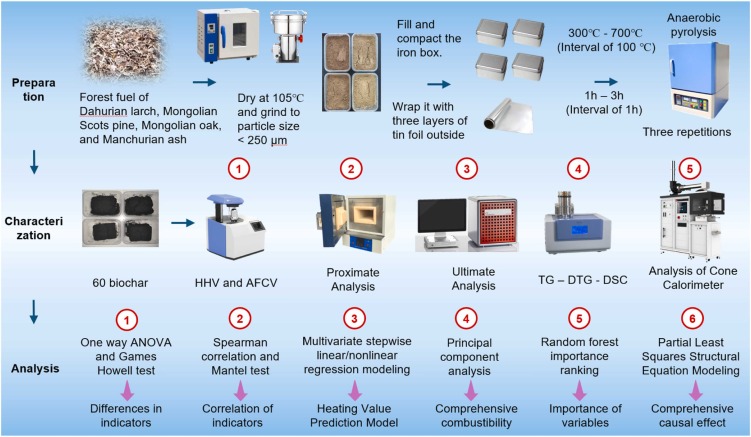
Woody biomass can be converted into useful forms of energy (heat or electricity), valuable bio-based fuels (i.e., solid, liquid, or gaseous fuels), or other products (e.g., polymers, bio-plastics, biochar, sorbents, and acids) using a number of different processes.
Thermochemical processing, one of the most common processing methods, uses heat and chemical action as a means of extracting and creating products and energy. Biochemical processing, another common approach, depends on microbes, enzymes, and other biological processes to transform the biomass.
Second-generation biofuels, produced from non-food biomass such as agricultural residues and wood, offer greater sustainability but encounter logistical and processing hurdles.
Woody biomass has several advantages compared to fossil
fuel in terms of lower carbon emissions, reduced threats of acid rain, and less particulate emissions. In addition, using woody biomass can potentially help regenerate the forest and improve forest health, biodiversity, and wildlife habitat.
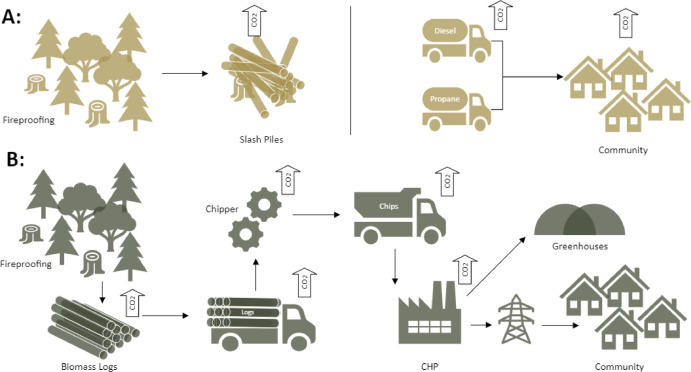
Application of Small-Scale, Local Biomass Energy
Wood bioenergy markets are complex. Woody biomass is used across a range from small to large scale and from low to high value.
At the low value and small scale, residential heat represents the largest share of wood used as a fuel in the United States. Many houses have wood heating and wood pellet furnaces.
Commercially, heat, perhaps using gasification technologies, is used in public institutions, including schools, hospitals, prisons, and municipality-owned district heating projects. Heat is also used for industrial processes such as sawmills, which may also produce electricity.
One of the most common bioenergy markets includes bioenergy facilities within the forest industry that produce most residues internally. The cost of wood fuel can be quite high because large volumes of fuel are needed to have a dependable and consistent supply of wood fuel (IE: 1,360 green kg (1.5 tons) per hour per megawatt of power generated) thus the economics is mostly dependent on location of the wood power facility.
However, wood power plants can find and do maintain a fairly low price and consistent fuel supply when adequate quantities are available. Staff foresters allow plant personnel to focus on operation while foresters focus on wood fuel procurement issues.
The Economics of Forest Management for Energy
Wood is generally a low-cost fuel, but the price can be extremely variable. The main factors influencing the price of woody biomass as a fuel include costs of getting the wood from forest to product, regional and international wood trade, and competing products. Costs that go into producing biomass products include collection, processing, and transportation.
These production costs vary significantly based on the following:
- Terrain
- Logging system and equipment used
- Volume per acre and total volume per site
- Contractor experience
- Road access and conditions
- Distance to market
It can sometimes cost more to collect, harvest, and transport logging residue or small-diameter wood to a biomass conversion facility than the value of energy that can be made from it.
A lot depends on the distance from the woods to a bioenergy facility.
On average, transportation costs often account for more than half the delivered cost and can be as high as 70 percent.
About 50 miles from a forest site is often recognized as the maximum distance someone would be willing to collect and transport forest biomass.
There are trade-offs between the economic cost and environmental impact of bioenergy production. Some highly mechanized operational methods, such as mechanical harvesting and whole-tree terrain chipping, may result in lower production costs, but may on the other hand raise specific environmental impact issues (e.g., carbon emissions, biodiversity loss).
The production cost is also sensitive to the intensity of forest management. Policies regarding the removal of trees in managed forests differ between countries, resulting in differing levels of environmental impact.
Conversion Processes
While highly abundant and sustainable, it faces limitations in transportation costs due to low density and technical challenges in breaking down its tough structure for fuel production:
- Thermochemical: Gasification, pyrolysis (including torrefaction to improve energy density), and liquefaction.
- Biochemical: Pretreatment followed by enzymatic hydrolysis and fermentation to produce bioethanol.
Lignocellulosic biofuels, particularly when converted via pelleting or advanced conversion technologies, have properties similar to coal, making them a viable, sustainable replacement.
Costs vs Amount of Energy Produced
The cost of forestry and agricultural residues is significantly lower than that of other biomass types. This is particularly significant given that the cost of non-residue biomass types is underestimated because the cost of land is not included. On the other hand, there is not a significant difference between the cost of grass energy crops, wood energy crops, and biomass from managed forest.
These costs result from a wide variety of production processes that are combined under diverse regional contexts and influenced by biophysical and socio-economic characteristics. For the same production site, costs can vary threefold depending on the production process. showed that the design of the harvest systems alone could result in production costs that are 70% higher. Biomass can be extracted from the production site to the road using different techniques (all-terrain vehicle, horse, or forwarder) which also heavily influences the production cost.
Production costs are also influenced by the scale of the operation. Wood-fuel production costs for small-scale systems were higher than larger-scales ones, the former being associated with relatively low productivity because of the physically demanding nature of the work.
The production phase corresponding to maintenance and harvesting has the highest relative cost across all biomass types. This phase generally includes several operations, i.e., fertilizer application, harvesting, and forwarding. In some regions these are mechanical operations demanding large capital investments, while they are labor-intensive in others, especially in the Global South.
For biomass from managed forest, the higher production cost revealed that the costs of a selective harvest (and lower productivity) usually did not compensate for the lower establishment cost when compared to the larger operational scale and higher establishment cost in wood energy crops.