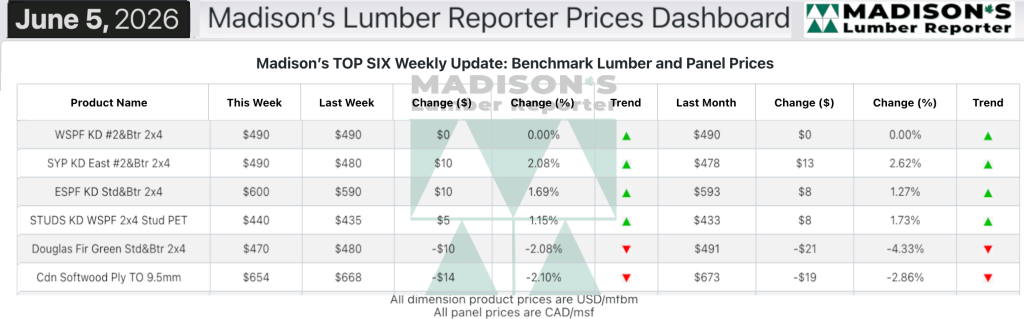
June arrived to forest products and building materials industry folks acknowledging the reality of ongoing tight supply.
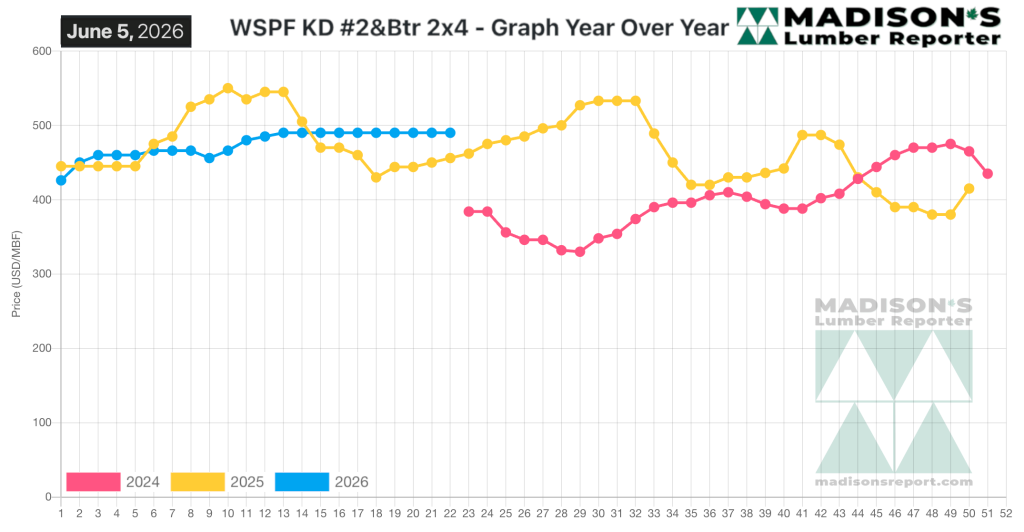
The rapidly increasing transportation costs only made the difficulty of sourcing solid wood products at lower prices more severe. Customers with the mentality of prior economics found themselves stymied by sellers who refused even small counter-offers. As sawmill order files ranged into the end of this month, lumber producers were unwilling to offer discounts.
Ongoing uncertainty with macro conditions and the possibility of even more disruptions to come kept players in a sentiment of caution.
Buyers and sellers alike continued to spend more time dealing with transportation issues, including sharply rising costs, than they did actually booking orders.
In the week ending June 05, 2026 the price of Western Spruce-Pine-Fir 2×4 #2&Btr KD (RL) was US$490 mfbm, which was flat from the previous week, said weekly forest products industry price guide newsletter Madison’s Lumber Reporter.
That week’s price was flat from one month ago when it was $490.
As June kicked off the lumber market still lacked clear direction; with some prices up, some down, and some flat.
To subscribe to Madison’s Lumber Reporter, simply fill out an order form here: https://madisonsreport.com/subscribe/
KEY TAKE-AWAYS:
• Traders of Western-SPF in the US reported a tenuous upward trend, supported by positive movement in lumber futures.
• Sawmill order files were into the latter half of June, making discounts increasingly difficult to find.
• Buyers tried to secure their mid-summer needs at the previous week’s prices, but mills held fast to their established lists.
• Customers of Eastern-SPF carrying short positions who had been waiting for a pullback in prices found themselves caught.
• The ESPF supply pipeline was demonstrably leaner than it has been in the past two years at this time.
• Southern Yellow Pine asking prices pushed as high as $10 to $15 above print as producers tried to pass on rising freight costs.
• Retail customers in the US northeast relied on just-in-time purchasing as external factors made every transaction more challenging.
- Traders of Western-SPF in the US reported a tenuous upward trend, supported by positive movement in lumber futures.
- Sawmill order files were into the latter half of June, making discounts increasingly difficult to find.
- Buyers tried to secure their mid-summer needs at the previous week’s prices, but mills held fast to their established lists.
- Customers of Eastern-SPF carrying short positions who had been waiting for a pullback in prices found themselves caught.
- The ESPF supply pipeline was demonstrably leaner than it has been in the past two years at this time.
- Southern Yellow Pine asking prices pushed as high as $10 to $15 above print as producers tried to pass on rising freight costs.
- Retail customers in the US northeast relied on just-in-time purchasing as external factors made every transaction more challenging.
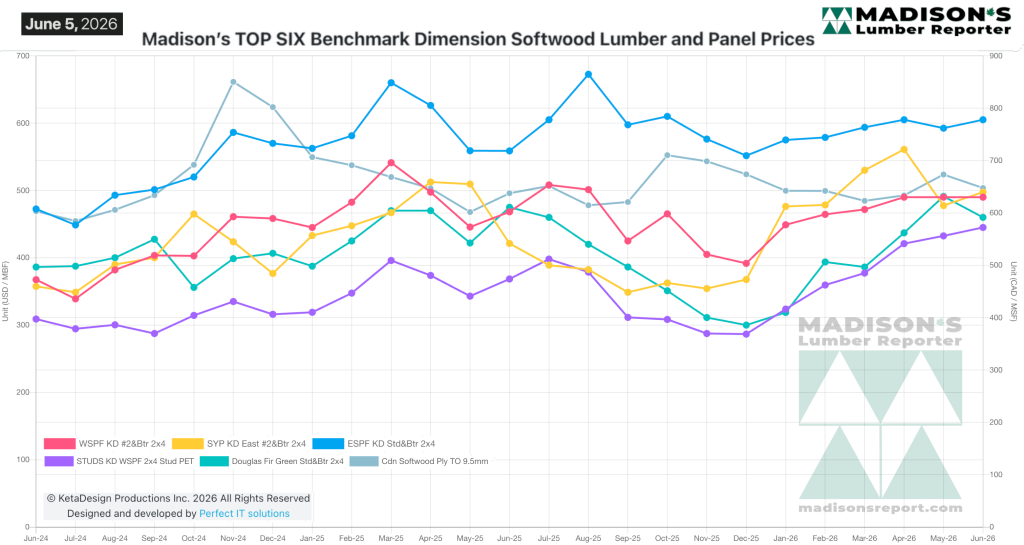
Madison’s Benchmark Top-Six Softwood Lumber and Panel Prices: Monthly Averages