
By Earl Heath, Madison’s Pellet Report Editor
Forest Sector in Dire Straits as Massive BC Pulp Mill Idled
In another blow to British Columbia’s forest industry, North American pulp, paper and packaging company Domtar recently announced it will indefinitely idle operations at its Howe Sound mill and Bayview Fibre chipping facility in Port Mellon, BC. The decision will remove approximately 380,000 metric tonnes of northern bleached softwood kraft pulp from the market annually, while affecting the futures of roughly 400 employees.
Company representatives cited several reasons for the move, including reduced demand from key overseas markets in Asia, unprecedented and persistently poor global pulp prices, and a precipitous decline in affordable domestic fibre.
The decision will have further-reaching effects than just the workers directly employed at the facility, as hundreds of local contractors, suppliers, businesses, and community members in the Sunshine Coast region of BC indirectly depend on the operation.
With more than 20 lumber mills and four pulp mills closing or curtailing since 2023, BC’s forest industry is clearly in dire straits. The loss of this crucial pulp and paper mill, as well as the nearby chipping facility, will create pressure on the local forest industry to find other avenues of disposal for low-value sawmill residuals. Biomass could offer a solution, but it would likely require support from government to offset high transportation and processing costs for the low-value waste.
To subscribe to Madison’s Lumber Reporter, simply fill out an order form here: https://madisonsreport.com/subscribe/
New UK Pellet Trade Association Launched
The UK Pellet Council lauded the recent launch of the Wood Fuel and Heating Association (WFHA), a new trade body established to provide coordinated representation for the country’s wood fuel and heating supply chain. The organization aims to bring together wood pellet, waste wood and chip suppliers, as well as biomass boiler distributors, installers, maintenance and compliance specialists, all under one unified advocacy group.
The association will focus on supplying low-carbon renewable biomass heat to homes, businesses and industrial facilities, while supporting employment in forestry and rural economies. This is particularly important in rural and off-grid properties and communities where heat pump deployment remains economically impractical or technically infeasible.
California Representative Introduces Legislation to Support Biomass Facilities
An independent representative in California recently introduced the Biomass Facility Construction Act, a bill that would create a tax credit totaling 30 per cent of the cost of construction for biomass plants. The bill would also allow biomass facilities to concurrently receive the existing tax credit for energy produced with biomass.
This legislation is aimed at reducing accumulations of biomass in California forests, which can exacerbate wildfire danger and severity. With increasing focus on wildfire mitigation efforts, the problem of disposal of this low-value biomass has been highlighted. The hope is that this bill will lead to the construction of more biomass facilities, creating more avenues for forestry contractors to offload waste residues and ultimately reduce wildfire potential.
US Forest Service Funds Bioenergy, Biochar Projects
In early August the United States Forest Service awarded USD$105.5 million in wood innovation grants to 177 projects including many biochar-, bioenergy-, and wood pellet-based endeavours.
The breakdown of these grants is as follows: $31 million for 113 wood innovation projects, $17 million for 23 community wood projects, and $57 million for 41 wood products infrastructure assistance projects. These initiatives will span 44 states, aiming to create and retain jobs, reduce wildfire risk, and improve forest health while expanding economic opportunities for forest products businesses.
Among the slew of biomass-based projects receiving funding are: a biorefinery in Bellemont, Arizona, to produce wood-based ethanol; wood energy and methanol production systems to increase low-value wood usage for an Arkansas biomass facility; new wood energy emissions control equipment at a biomass facility in Hawaii; a wood energy system at a drum manufacturing plant in Maine; a biomass heating system to increase low-value wood usage in two Alaskan communities; and a massive rotary pyrolysis unit in southwestern Washington to utilize low-value mill residuals in support of the regional timber sector; among scores of others.
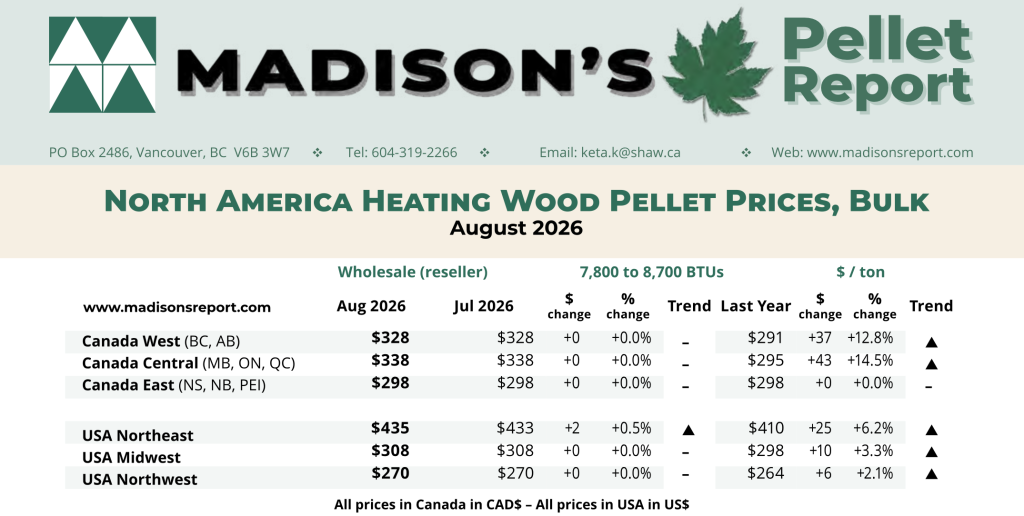
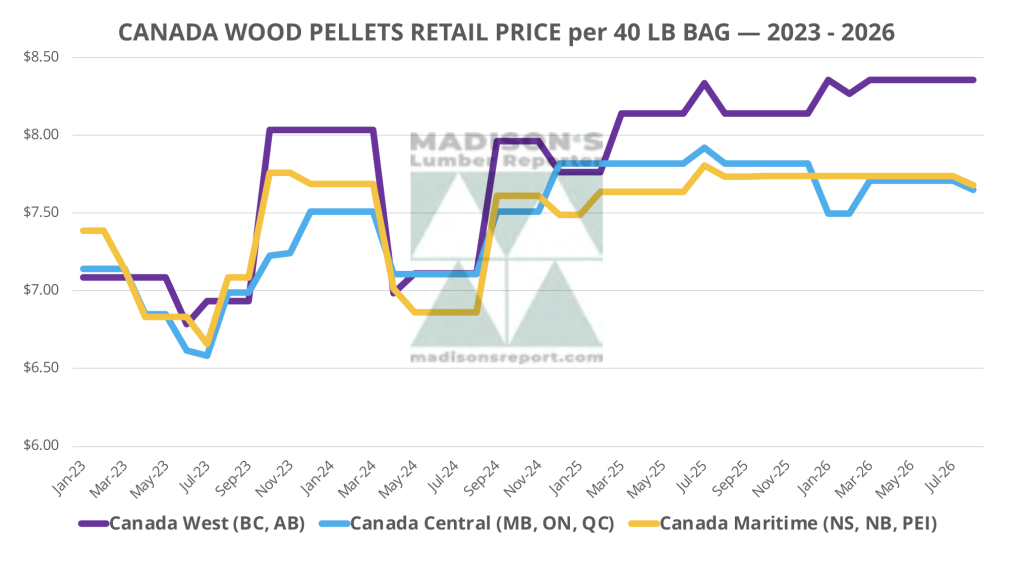
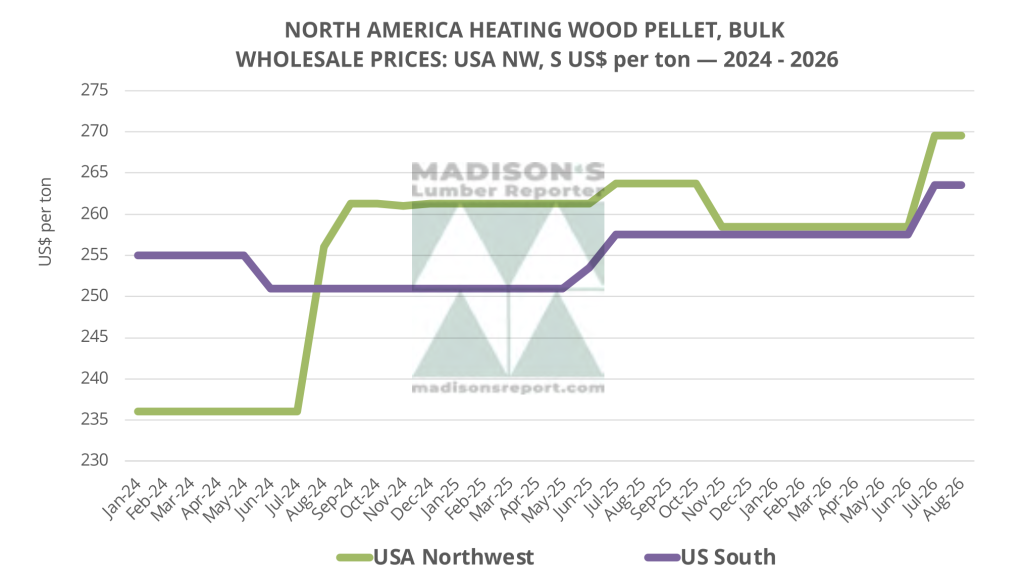
Madison’s Heating Wood Pellet report is a monthly publication, tracking U.S. and Canadian commercial and residential heating wood pellet prices. It includes detailed data on wholesale commercial/retail prices, production volumes, sales, export volumes and values, competing home heating fuel prices, plus more.