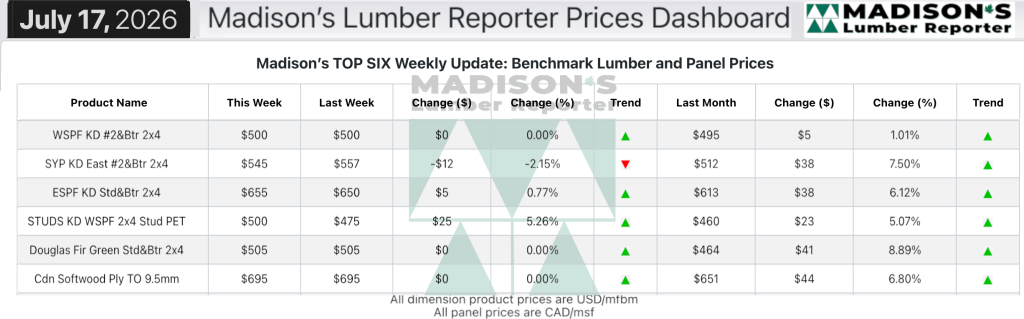
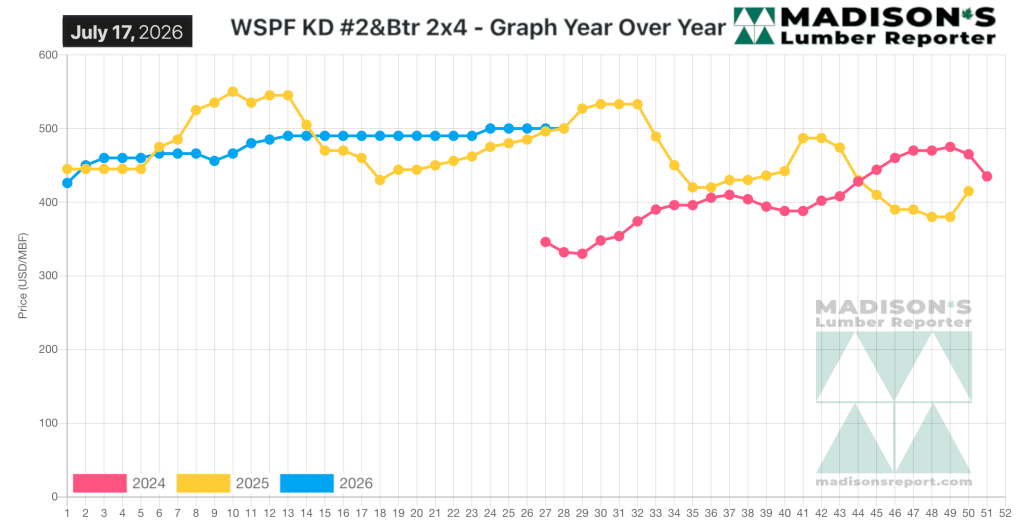
The most important thing to note for mid-July 2026 is that the benchmark Western S-P-F 2×4 price is equal to same week last year.
As always, Madison’s is the first to point out such trends with lumber price changes, which provides industry with the best insight to make their own business plans.
Given that the other data sets are known; housing starts, home prices, interest rates, home sales, etc; anyone looking for information about what operational changes to make — whether at a sawmill or a construction site — will find it right here with Madison’s Lumber Reporter.
New housing construction for the past couple of years has been uninspiring at best. The response from lumber producers has been to keep manufacturing volumes lower so supply will stay in line with demand.
Evidence that this discipline is working is demonstrated by the very regular price changes throughout the year, as home building season comes on then wanes.
As Madison’s has said before during this year; we now know what is the price bottom for lumber products.
A quick look at the graph below show the same week two years ago, this benchmark WSPF 2×4 prices was 51% lower than it is now, at US$332 mfbm.
Do not expect to see those prices again as 1) that is below cost-of-production, and 2) the sawmills will not bring more lumber manufacturing online until demand improves significantly.
In the week ending July 17, 2026 the price of Western Spruce-Pine-Fir 2×4 #2&Btr KD (RL) was US$500 mfbm, which flat from the previous week, said weekly forest products industry price guide newsletter Madison’s Lumber Reporter.
That week’s price was up +$5, or +1%, from one month ago when it was $495.
Commodity prices were firm or strengthening as players felt summer doldrums had arrived; demand waned in several categories.
To subscribe to Madison’s Lumber Reporter, simply fill out an order form here: https://madisonsreport.com/subscribe/
KEY TAKE-AWAYS:
• Sellers of Western-SPF in the US enjoyed lively inquiry and takeaway early in the week.
• Purchasers continued to be focussed on short-term coverage rather than on building inventories.
• Manufacturer supply levels were still below average and order files were around two- to three-weeks.
• Buyers of Western-SPF in Canada were more circumspect than in previous weeks.
• Eastern-SPF sawmills maintained order files in a two- to three-week range.
• Buyers of Southern Yellow Pine reduced their activity to frequent fill-in trucks, covering only their immediate needs.
• Largely unforeseen bottlenecks and logistical problems influenced market direction heavily this year.
• Eastern stocking wholesalers continued to manage subpar inventory levels amid a shifting market.
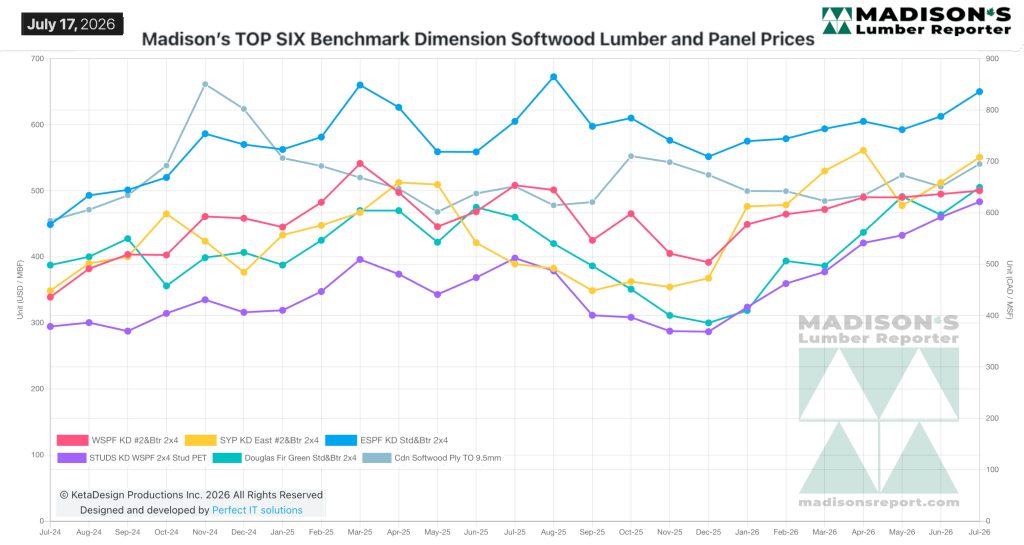
Madison’s Benchmark Top-Six Softwood Lumber and Panel Prices: Monthly Averages