
By Earl Heath, Madison’s Pellet Report Editor
Major Federal Funding Announced for Canadian Bioenergy Sector
Natural Resources Canada announced in early June that nearly CAD$130 million will be awarded to 56 projects, with a focus on wood pellets, bioenergy, and biocarbon initiatives. The funding is part of a broader strategy to transform the country’s forest sector by developing new low-carbon wood technologies, expanding the use of mass timber in construction, supporting indigenous participation and forest-sector businesses, boosting value-added wood product manufacturing, and helping diversify Canada’s export markets.
The 56 projects receiving funding cover a wide array of forestry-related endeavours, with biomass playing a key role. The Wood Pellet Association of Canada will receive $473, 871 to assess export readiness for thermally treated pellets, with a focus on priority markets in the European Union and Japan.
The Forest Enhancement Society of BC will receive $37 million to increase the use of low-value and residual forest fibre by supporting its collection, processing, and transport.
And the Apitipi Anicinapek Nation will receive $267,500 for a project focussing on business planning, partnership development, feedstock analysis, governance planning, and feasibility activities to support the development of an indigenous-led
biochar and biocarbon facility utilizing forest biomass residuals in Northeastern Ontario. A full list of awards can be found on the Natural Resources Canada website.
ENplus Reports Record Year for Certified Pellet Production
Bioenergy Europe recently reported that the ENplus certification scheme has confirmed its highest volume of certified wood pellets in 2025, reaching 14.5 million tonnes. ENplus asserts that it is the world-leading certification scheme for wood pellet quality, ensuring high standards across the entire supply chain and supporting the development of a transparent and reliable market.
Based on data submitted by certified companies, certification volumes are expected to continue growing and exceed 15 million tonnes worldwide in 2026.
Germany continues to be the leading country with approximately 3.95 million tonnes certified in 2025, with Austria and France following at 1.89 million tonnes and 1.08 million tonnes respectively. Poland was again the country with the most ENplus certified pellet producers, while Germany had the most certified pellet traders.
ENplus noted a considerable increase in the number of Chilean producers seeking certification, with more than 10 joining the scheme in the past year.
To subscribe to Madison’s Lumber Reporter, simply fill out an order form here: https://madisonsreport.com/subscribe/
Ontario Government Invests in Biofuel
The Ontario government announced last month it will invest CAD$5.5 million to support a project by Greenwater Technology that will produce renewable diesel and sustainable aviation fuel from mill waste residuals and other underused fibre. The investment is part of a push by the provincial government to create new revenue streams to drive growth in the forest industry and help businesses adapt and compete amid tariffs and duties reshaping trade relations between Canada and the US.
Most of the funding will be issued under Ontario’s Forest Biomass Program’s Innovative Bioproduct Manufacturing stream, which develops technologies to increase biomass use, diversify the forest sector, and build the industry’s competitive advantage in changing markets. A small portion will be provided under the Northern Ontario Heritage Fund Corporation, which supports and protects northern industries and jobs by securing new opportunities for the long-term prosperity of Northern Ontario.
Proposed Pacific Northwest Biomass Plant Faces Legal Challenge
Several environmental groups recently launched a legal challenge to block construction of an industrial-scale wood pellet facility at the port of Grays Harbor in Washington state. The plant would have a capacity of roughly 440,000 tonnes of wood pellets annually, for export to Asian energy markets via the aforementioned port.
Its backer, Pacific Northwest Renewable Energy, obtained a permit issued by the Olympic Region Clean Air Agency that concluded the proposed facility will not jeopardize ambient air quality and would meet criteria for approving new air pollution sources in Washington.
Detractors argue the permit underestimates toxic air pollutant emissions, citing concerns about constructing the plant adjacent to the Grays Harbor National Wildlife Refuge and within a mile of several local schools.
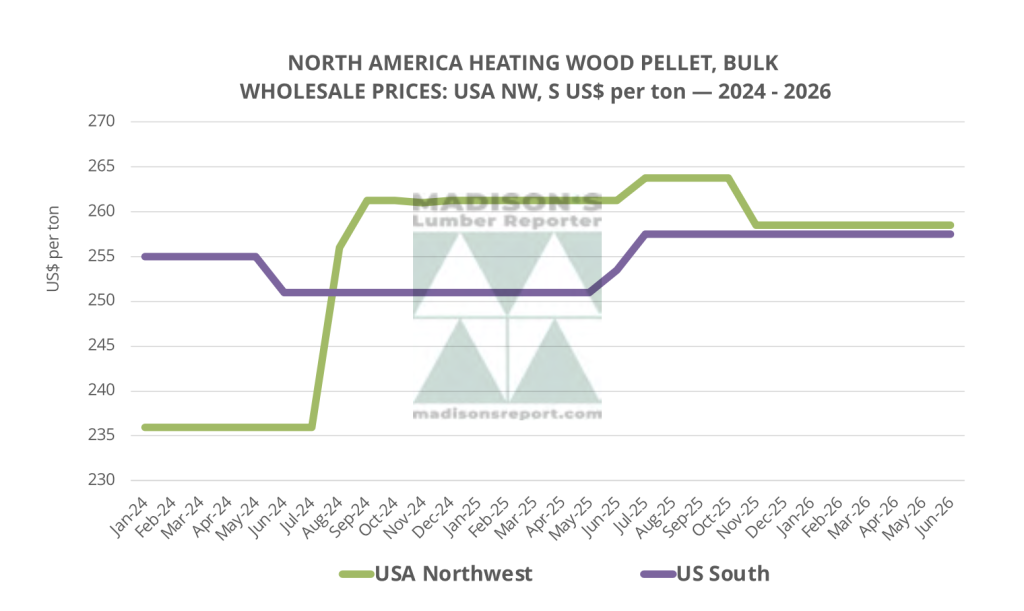
Madison’s Heating Wood Pellet report is a monthly publication, tracking U.S. and Canadian commercial and residential heating wood pellet prices. It includes detailed data on wholesale commercial/retail prices, production volumes, sales, export volumes and values, competing home heating fuel prices, plus more.